Penuche: A Natural Handwritten Font for Crafters & Sellers
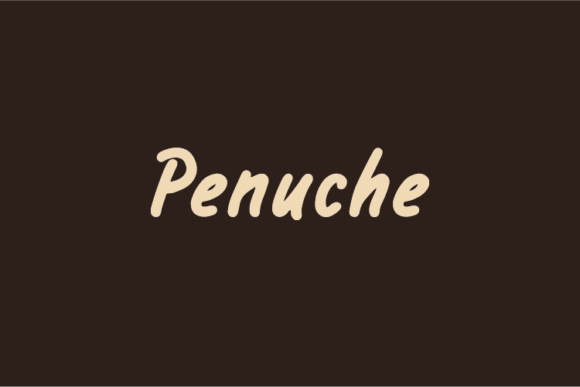
If you’ve ever spent hours tweaking a script font—smoothing curves, adjusting spacing, or manually nudging nodes just to get that “real pen-on-paper” warmth—you’ll love Penuche. This isn’t a digitized imitation. It’s a natural handwritten font built from authentic strokes, where every character’s indentation and rhythm stays untouched—no artificial smoothing, no node manipulation. That honesty shows up in your final product: softer edges, organic flow, and a quiet confidence that says “handmade with care,” not “designed on autopilot.”
As someone who makes printable wedding suites, laser-cut wooden tags, and small-batch candle labels, I reach for Penuche when I need personality without sacrificing polish. It’s not overly ornate—no dramatic swashes or distracting flourishes—so it reads clearly even at 12pt on a kraft paper gift tag. And because each letterform retains its natural variation (subtle width shifts, gentle pressure changes), it avoids the robotic repetition that can make other script fonts feel cold or generic.
For physical product makers, readability is non-negotiable—and Penuche delivers where it counts. On Cricut or Silhouette mats, it cuts cleanly at sizes as small as 0.25" tall, especially when used with clean vector outlines (which Penuche provides in OTF and TTF formats). I’ve used it for mini sticker sheets of affirmations, and customers consistently comment on how “easy to read” they are—even when layered over textured backgrounds. For larger applications like farmhouse-style wall signs or acrylic welcome boards, Penuche holds presence without shouting. Its moderate x-height and open counters mean it doesn’t clog up when painted or engraved.
Think about what you’re making *right now*: a set of linen tea towel labels? Penuche adds subtle charm without competing with the fabric’s texture. A batch of holiday soap packaging? It softens the visual weight of bold product names while keeping them legible on shelf. Wedding welcome signs? Yes—it pairs beautifully with calligraphy-style headers, but also stands alone with quiet elegance on a chalkboard-style digital printable. I even use it for boutique clothing tags: printed on recycled cardstock, it gives that “curated, intentional” vibe buyers associate with premium handmade goods.
Where Penuche truly shines is in consistency across touchpoints. If you sell digital downloads—planner stickers, quote posters, or Canva-ready invitation templates—using Penuche across all assets builds instant brand recognition. Customers begin to associate its gentle slope and honest stroke with your shop’s voice. That emotional resonance matters: a birthday card in Penuche feels personal; a mug design in Penuche feels warm and inviting—not like stock clipart.
It’s ideal for short, high-impact text: names on baby onesies, shop logos on tote bags, titles on printable wall art, or phrases on enamel pins. It’s less suited for long paragraphs—but that’s by design. Penuche is a display font, part of the Script Amp category, meant to elevate moments, not explain them. Use it for headlines, quotes, monograms, and product names. Pair it thoughtfully: try it with a clean sans serif like Montserrat or Inter for contrast (e.g., Penuche for “Hand-poured Soy Wax” + Montserrat for “Vanilla + Bergamot • 8 oz”). Or go warm and cohesive with a soft serif like Playfair Display for formal stationery—keeping hierarchy clear without losing cohesion.
Inside the Penuche package, you’ll find standard OpenType features—ligatures for natural “fi”, “fl”, and “ff” connections, plus stylistic alternates that let you swap in slightly more relaxed or upright versions of letters like “a”, “g”, or “y”. These aren’t flashy extras—they’re practical tools. One alternate “s” might sit better beside a capital “T” on a t-shirt design; a ligature keeps “to” from looking cramped on a tiny sticker. No multilingual glyphs are included, so stick to English, Spanish, French, and German for now—but that covers most craft markets I work in.
Licensing is straightforward—and vital if you’re selling physical products or digital files. Penuche is a commercial font, meaning you can use it freely in client work, printables, SVG cut files, merchandise (tees, mugs, stickers), and packaging—as long as you’re not reselling the font file itself. That’s huge for Etsy sellers and small studios: no need to hunt down extended licenses for every new product line. Just keep your original download secure, and you’re covered for both physical and digital distribution.
I keep Penuche in my top three go-to fonts—not because it’s trendy, but because it works. It works on matte-finish greeting cards that go through postal sorting. It works on heat-transfer vinyl for cotton tees. It works in Procreate sketches before moving to final SVG prep. And it works when a customer opens a digital download and thinks, “This feels made just for me.” That’s the power of a natural handwritten font built with integrity—not algorithms.
Whether you're designing a spring collection of planner stickers, launching a new line of herbal tea blends, or creating a signature welcome board for your wedding rental business—Penuche brings authenticity without extra effort. It doesn’t ask you to fix it. It asks you to trust it. And in the daily rhythm of making, shipping, and selling, that kind of reliability is rare—and deeply valuable.